In 2026, every marketing team is asking, how should we actually standardize our AI tools? Just a few years ago, this question was far less important. AI tools had narrow models with rough outputs, and most marketers interacted with AI tools as a quirky way of brainstorming new headlines. That time is gone. ChatGPT, Gemini, and Claude have become general purpose assistants that draft marketing campaigns, analyze customer data, create marketing assets, and even perform workflow automation. The issue is no longer capability. It’s choice.
This guide aims to describe how ChatGPT, Gemini, and Claude actually perform the most important marketing tasks, such as writing text and generating images, as well as performance in research, integrations, pricing, and overall enterprise readiness. Rather than finding a single winner, we would like to show you which choice has the most merit, and the most hidden flaws, so you can choose the best option for your team, rather than following whichever company has the most aggressive marketing.
Why This Will Compare More Now Than It Has in The Past
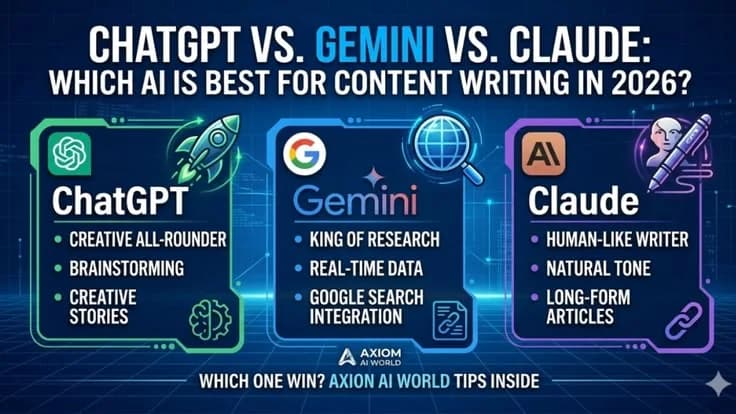
To the question "which AI is best" in 2026, there is a truthful answer. It has never been easier to identify the best models, and those models have never been so close. Independent testing and performance of the three main models have actually shown minimal differentiation in capability. Now, the most important differentiators are design, optimization, and the ecosystem to which the AI interfaces.
OpenAI has embraced ChatGPT as an all-in-one generalist assistant, incorporating chat, images, code, and voice in one offering. Claude from Anthropic has been established as a specialist in reasoning and quality writing, excelling in human-preference rankings in open-ended and nuanced tasks. Scale, cost, and the extent of integration with Search and Workspace are the pillars of Gemini from Google. All of them have a point, as they focus on optimizing for different tasks. This is why marketing teams use various tools, rather than a single tool, as each marketing task can focus on different things.
ChatGPT for Marketers
Strengths
- Versatility and tool ecosystem: For the range of inbuilt tools, browsing, and even code execution, ChatGPT is considered to be the best all-in-one assistant. This is likely due to the ecosystem of plugins and integrations that are included in the same conversation.
- Integrated tools for image generation: Having image generation capabilities built into the platform is a game changer for marketers that need images in the form of social graphics, ad ideas, or even moodboards.
- High energy, casual tone: ChatGPT's tone has been shown in many independent experiments to have a high energy and casual tone, which is ideal for social campaigns and messaging that needs to be executed in a rapid manner.
- Business reasoning: In a blind evaluation, competitive strategy and business decision prompts were best answered by ChatGPT. This suggests a strength for ChatGPT in more logical or analytical tasks compared to other assistant tools.
Weaknesses
- Accuracy trade-offs: Compared to Claude and Gemini, ChatGPT is evaluated as most likely to be incorrect but still confident, which is an important factor for marketing when the generated content includes data, statistics, or frequently verifiable claims.
- Rising cost: ChatGPT is often the most expensive premium subscription due to price increases in the higher tiers.
- Writing quality in head-to-head tests: In pure writing quality tests, which are done in a blind and unbranded format, ChatGPT has lagged behind Claude while remaining competitive in the other metrics.
Bottom line: As a tool for doing many different jobs, including copy and image generation and even basic automation and research, ChatGPT is a good all around choice, especially for content creators and social media managers who need creative content quickly.
Gemini for Marketers
Strengths
- Live, grounded research: Because Gemini is integrated with Google Search, the information that Gemini uses to answer questions is up to date and not just from training data. This is a great benefit for research, monitoring, or tracking anything that is timely or more current.
- Workspace-native workflows: For teams already living in Gmail, Docs, Sheets, and Meet, Gemini plugs directly into existing tools, letting marketers draft, analyze, and act without leaving their normal workflow.
- Greatest value and largest free tier: Gemini is often regarded as the most attractive free option, and its API pricing tends to be the most affordable per token, which is important for teams doing large-scale AI work.
- Large context window: Gemini is the leading option by a wide margin when it comes to raw context, which is especially important for marketers who deal with large datasets, lengthy transcripts, or large archives.
Weaknesses
- Diminished value for teams outside Google: For teams that do not operate on Google Workspace, Gemini loses a lot of its structural advantages, and when it comes to non-Google applications, its integrations are quite limited.
- Unreliable creative output: Reports indicate that the quality of Gemini's image generation through Imagen is quite inconsistent and that access to the service varies by tier and region, so it is not the best option for image-based campaigns.
- Average writing voice: In a series of blind writing tests, Gemini rarely generated the best quality writing, but it also did not generate the poorest quality writing, so it is a solid, but unremarkable, writing option.
Bottom line: From a writing and research standpoint, Gemini is a solid option for work that is Google-centric and for work that requires current research, even though it is not the most polished writing.
Claude for Marketers

Strengths
- Best writing quality: Claude has been the best option for writing, as it generates the most natural and least "robotic" writing, and writing that is precise and on target in terms of style and voice.
Blind-test performance: In an anonymous, decoupled vote (where participants voted without seeing any labels) that evaluated the outputs, Claude won in 50% of the cases and did so with considerable margins, especially when the prompts were centered around writing.
Long-document reliability: Claude’s large context window is highly appreciated not just for its large size but for its reliability and consistent performance, keeping coherence and accuracy in long documents, including brand and campaign guides, style guides, and campaign briefs.
Accuracy and trustworthiness: Reviewers rate Claude high among three in terms of factual accuracy, which matters in regulated industry as well as for brands that cannot afford Claude’s built-in the wrong AI-generated claims.
Enterprise and privacy posture: Claude has built a strong enterprise reputation in finance, legal, and healthcare, and other industries where accuracy and data privacy are of concern, and provides a relevant signal for marketing teams in larger regulated organization.
Weaknesses
No native image generation: Claude cannot generate images, so visual marketing workflows still need to rely on other tools.
No native real-time web access in the base product: Given that Claude’s knowledge is based on the data it was trained on and its cut-off, for fast research and real-time tools, Claude is not the best option when compared to a research web-based assistant.
Smaller casual ecosystem: Compared to ChatGPT, Claude has a smaller ecosystem of plugins and third-party integrations, and enterprise pricing is usually negotiated on a case-by-case basis instead of being published clearly.
Ultimately, Claude remains the best option when the final product is written text, for example, blog posts, email campaigns, whitepapers, or ad copy. Claude excels at producing text that sounds human. Claude is also better at producing text that mirrors the ideal brand voice when compared to tools that produce visual and text elements simultaneously.
Tool Comparison

The table below shows the comparison of the three tools for the tasks that are most important to marketers. This is based on reviews that were conducted independently and on blind tests.
Use Case ChatGPT Gemini Claude
Long-form brand copy Good Good Best
Social & ad creative Best Good Good
Real-time research Good Best Limited
Image generation Best Good None
Long documents / brand guides Good Best (size) Best (accuracy)
Google Workspace teams Fair Best Fair
Enterprise data privacy Good Good Best
Results of Blind Tests
As useful comparisons between vendors are, they can easily be dismissed as marketing spins, especially when the vendor's tool gets the most favor in the review. This is what makes blind unbranded tests more convincing. In one such test, over a hundred participants voted for outputs that were given to them for 8 different types of prompts. During the test, no hints or names of the tools were given.
The outcomes deviated from the trends vendor marketing typically sees. Claude won four of the eight rounds, and those wins were dominant, with Claude scoring 35 to 54 percentage points ahead of the closest competitor in the majority of the rounds. ChatGPT scored one round, which was a notable round: when scored for the best response to a price cut posed by a competitor, this suggests a business strategy response has an advantage over open-ended creative response. Although Gemini scored no wins, it also finished no rounds in the last position, and was in the second position in all of the rounds, earning it the title of the reliable generalist.
For marketers, the lesson is not to "always go with Claude." Rather, when quality of writing and brand voice is the primary consideration, Claude is quantifiably and consistently superior, and ChatGPT and Gemini add value in different contexts.
Pricing: What You're Actually Paying For
When it comes to individual subscriptions, pricing for a pro version has converged to a similar price of about $20 across the three tools, which means pricing is not a consideration when a personal assistant is being selected for individual use. The value is revealed at scale.
- API and automation costs: for a per token cost, Gemini is generally the most cost-effective option if automated content creation is the primary concern rather than an interactive chat.
- Team and enterprise tiers: The team plan for ChatGPT is easiest to buy and expand. Gemini easily integrates into Google Workspace subscriptions. For Claude, generally a custom enterprise conversation is required. This makes buying slower, but generally means more extensive compliance and data-handling for regulated industries.
- Hidden costs: Count the cost of switching tools and training staff on the new prompts and workflows, and the productivity that is lost if your team pays for three subscriptions, but uses each one for a narrow purpose.
Choosing Based on Your Team's Actual Work
Rather than asking which AI is best, a more relevant question is what does my team do the most? Here’s how this looks like with some examples:
- Content marketing, blogs and emails: Claude. This tool has consistently and measurably better long-form writing, and is better for brand consistent writing.
- High-volume creative work: ChatGPT is better because of its built-in image generation, and faster, more varied tone makes ChatGPT better for social media work.
- Competitive research and market monitoring: Gemini, because of its native search grounding.
- Teams using Google Workspace: Gemini due to the existing integration.
- Industries like finance, healthcare, and legal marketing: Claude for its enterprise data handling and due to its focus on client safety and more compliance.
- Teams that prefer consolidating lots of functionality into a single tool and managing fewer subscriptions: ChatGPT, which balances depth and ecosystem breadth with reasonable compromises on writing refinement and accuracy.
The Multi-tool Reality
By 2026, the most advanced marketing teams won't operate on a single assistant. A common, effective pattern includes Claude for drafting and editing long-form copy, ChatGPT for generating related images and quick creative edits, and Gemini for research and staying up-to-date with competition and market shifts.
This pattern creates friction, such as multiple logins and the added burden of knowing which tool to use for which task. But for the teams that can afford the friction, using the best model for each task is a better approach than forcing all tasks through one assistant. You should aim to manage at least three tools for your team, but if you can't, the fallback is simple: choose the assistant that best fits your most common task. If writing is your most common task, go with Claude. If your most common task is generating different versions or related images, use ChatGPT. If you do your research with Google, go with Gemini.
Enterprise and Data Privacy Considerations
The AI tool selection for marketing teams in big organizations is more complex than opting for a preferred product. Marketing teams have to consult legal, security, and compliance teams, and the stakeholders of the three teams have to agree to the selection. All three products have enterprise-grade security controls, but the difference matters. ChatGPT Enterprise is designed for broad, multi-industry, multi-integration product spaces, whereas Gemini for Workspace is integrated in the Google data governance and admin console which provides a compliance advantage for teams using the Google security model. Claude is enterprise-focused, and offers advanced enterprise-grade security for finance, legal, and healthcare, which are the easiest fields of enterprise-grade security to assess.
Adopt a conservative approach and assume that no vendor’s or service’s default settings will meet your company’s settings. Data retention and model training policies, chat residency, regional data residency and compliance (e.g. SOC 2, HIPAA, and GDPR) invariably have to be verified with service providers rather than relying on reputation.
Frequently Asked Questions
Is Claude better than ChatGPT for marketing copy?
Claude is the superior choice if you only consider writing quality and branding; targeted blind and independent studies have shown that Claude is better. ChatGPT offers more creativity and versatility, built-in image generation, and tool integrations, and is therefore the better choice for those that value creativity and versatility.
Which AI tool is the most affordable option for marketing teams?
Gemini, GPT-4, and Claude are priced similarly at about $20 per month for individuals, so nothing differentiates them at that level. Pricing for tokens at scale is usually lowest for Gemini, making it the most affordable out of the trio for teams wanting to integrate Gemini into content pipelines for high volume automation.
Can Claude create images as a part of a social media campaign?
No. Claude can view images and provide an analysis of them, but is not capable of producing original images. For teams wanting to automate graphic design and copy generation, it is common to pair Claude with ChatGPT and a design tool.
Do marketers need to have multiple AI tools?
Not really, but multiple tools at their disposal is something most winning teams have. As long as a team is disciplined enough to maybe juggle several subscriptions, splitting tasks up among various tools is likely to provide better results than relying on a single tool.
Final Verdict
There is not going to be just one superior AI tool for marketers starting in 2026 because there is a superior AI tool for each use case and the smartest teams have recognized that. From a content-centric marketing perspective, Claude is the best option because it excels in quality, consistency and being factually accurate. ChatGPT still retains the spot as the best tool for all purposes due to the innate creativity and quick tool for graphic design and inspiration. For research, Gemini is the best option, especially for teams using Google Workspace.
In 2026, the biggest competitive advantage won't come from selecting the 'best' brand. Rather, it will be from having the knowledge of these trade-offs to assign the correct task to the correct model, and having the discipline to follow through on this, campaign after campaign.