Meta Ads AI Stack: Andromeda, Claude & Performance Ads
A deep dive into Meta's Andromeda ad-ranking AI and Claude's role in Meta advertising — how the AI-powered Meta Ads stack is changing targeting, optimization, and ROI for advertisers. Primary Keyword: Meta Ads AI stack
22 min read
Introduction. A New Chapter For Facebook And Instagram Advertising
Digital advertising is constantly shifting. Any social media ads manager understands that there have been many changes to the Facebook Ads Manager in recent years. For a while, it rewarded managers spending the most time adjusting their ads’ audiences, placements, and bids. Although this is still technically allowed, it is increasingly not advised. In the meantime, two trends are dictating how ads will be planned, built, and optimized on Meta’s apps: Andromeda and Claude.
Andromeda rates ads, and Claude is an AI writing assistant. Together, they provide what Meta is calling “AI-assisted” advertising. What this means for Marketers, Business owners, and Agency owners in Bengaluru and beyond is understanding that this combination makes unprecedented changes to how all of Meta's advertising tools are used.
This resource will provide everything you need to know to understand Andromeda and the impact it (alongside Claude) will have on future Facebook Ads optimization, including the potential for better audience targeting, and stronger return of ad spend.
What is Meta Andromeda? Unravelling the Mystery of Meta's AI Ad Ranking System
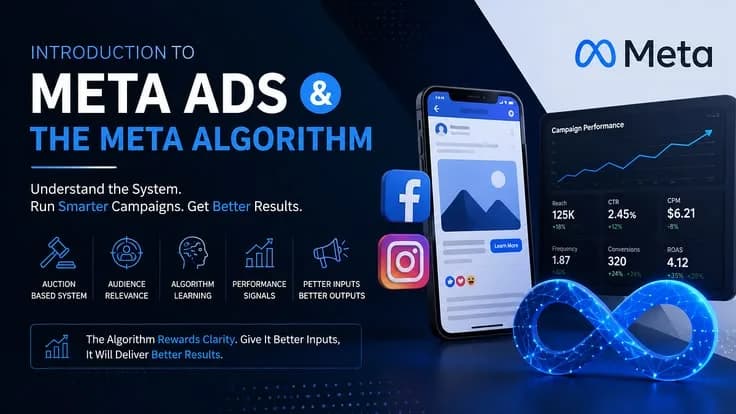
Andromeda is Meta’s machine learning system for ad recommendations across Facebook, Instagram, and other applications within the Meta family. Andromeda’s tasks may seem simple to describe, but are very complex to execute: matching the appropriate ad to the appropriate user in the appropriate moment among the billions of possibilites in a fraction of a second.
Prior to Andromeda, Meta’s ad ranking systems used relatively simple retrieval methods to determine the ads that should be considered for a given user. Andromeda alters this by applying deep learning to the retrieval stage in a way that prior systems have not. Rather than settling for lefony-based filtering rules, Andromeda uses sophisticated neural networks to understand the intricate details of the user, their behavior, their interests, and their intent and connects those observations to the offerings and services being advertised.
Advertisers should be excited by the results that Meta has achieved with Andromeda. Internal studies have shown improvement in ad quality within selected segments and an improvement in return on ad spend for advertisers that employed AI-based features instead of adhering to an audience-building strategy of purely manual audience building. Meta has built complementary systems to Andromeda. For example, there are components of Reels conversions, sequence modeling, and ranking that are focused on improving ad relevancy and ad performance.
Advertisers are learning that machine learning strengthens businesses that leverage AI’s ‘creative’ capabilities. By comparison, ad campaigns that rely on overly complicated manual targeting diminish in performance. Andromeda does a lot of the heavy targeting work already. Thus, ads targeting performance is not the core issue. Rather, the primary concern of advertisers is, "what can we feed the system to improve its input and performance?"
Claude: AI That Thinks, Analyzes and Generates Strategy
While Andromeda analyzes ad performance, Claude directly interacts with advertisements and has the potential to improve leading marketing campaigns. Anthropic’s Claude is designed to excel in AI, and has a focus in both reasoning and writing. For marketers, the Model Context Protocol developed by Meta will connect optimize ads systems and Claude to a business's Meta Ads account.
In that state, a marketer is able to verbally communicate with Claude to engage with advertising tools related to the performance, ad variation, campaign creation, and adset management. Rather than navigating numerous layers of ads manager, Claude can be asked to build a new campaign or assess the performance of the last campaign.
Compared to many of the so-called AI-enabled ad tools, Claude is a real game-changer. Most of these tools simply automated bid optimizations and provided audience suggestions. What makes Claude unique is the ability to provide rational explanations to the ad performance data. Claude can determine why certain ad sets are failing. It provides recommendations to advertisers on the ad set's creative and the audience targeting and converts a messy ad campaign data into a flexible and understandable ad campaign strategy. For marketers managing multiple clients, this is a huge time-saver.
Andromeda and Claude Together

When considering Claude and Andromeda, it helps to think of the two systems working on the advertising process at different layers.
Andromeda is an ad platform. It runs in the background. Marketers do not deal with Andromeda. They simply prepare clear ad campaigns and set up effective creative and robust ad tracking to benefit from Andromeda's services.
Claude works at the marketer interface with the layer of strategy and execution. This means that Claude helps transform business goals into campaign structures. Claude helps makes revisions on ad copy and interprets the data of ad performance, and can make changes for the ad account by utilizing the connected tools. When compared to Andromeda, which optimizes ad delivery behind the scenes, Claude works directly with the human marketer on the decisions that dictate what can be delivered by the system.
Claude and Andromeda have a complementary role to the human marketer. The marketer has control of the strategy and goals, while Claire focuses on the construction of, analysis, and refinement of campaign build based on the strategy, and Andromeda makes real-time optimizations on ad delivery. The combination of this workflow has led to the user experience that Meta and industry observers describe as having four main themes: AI-generated leads, improved automation, smarter ad targeting, and improved ROI.
AI-Generated Leads
Andromeda uses deep learning models of user intent and interest to understand audience targeting at a level that manual audience building cannot compete with. Rather than guessing at an audience of interests, age ranges, and lookalike audiences, the audience is improved based on the learned behaviors of actual conversions. In expansive audience targeting coupled with strong creative and ad copy with clear calls to action, marketers that rely on broad audience segmentation over narrow, manual audiences tend to perform better.
AI-Powered Optimization
Performance reporting and anomaly detection are components of Claude that empower marketers to make adjustments on the fly—something that was not previously possible when a marketer was stuck running several accounts at once. Instead of waiting for a report to come out each week, marketers can now ask Claude to perform ad set, budget, and conversion rate analysis at any given moment for an instant analysis.
High-Quality Leads
Andromeda’s ad optimization framework is built to look beyond surface-level engagements, making the leads advertising campaigns acquire often of a significantly higher quality. Claude also helps fine-tune advertisements, lead value capture structures, and follow up outreach, further enhancing campaign outcomes for business concerns that implement lead generation campaigns on Meta.
Higher ROI
Andromeda and Claude, when used together, tend to create synergy. Advertisers spend less time on tedious optimization and more time refining winning ads because the system takes care of optimization at a scale that is impossible for humans to achieve. Meanwhile, the optimization framework becomes more effective at serving ads.
What This Means for Digital Marketers and Business Owners

Digital marketers already in the field will now have to redefine what it means to be skilled in Meta Ads. Five years ago, audience segmentation, interest stacking, and bid adjustments (to an extreme degree) were almost all a digital marketer had to tackle. Now, digital marketers must have a strong command of creative strategies along with strong campaign architecture and conversion tracking. They must also know how to make sense of insights and recommendations provided by AI and translate that knowledge into strategy.
For businesses, this also means adopting a new expectation. The digital marketer who can manage their account within the tools and services provided by the AI, such as Claude and Andromeda, will succeed. Digital marketers who still conduct their practices the way they were done in 2019 will fail to meet expectations. The agencies and marketing teams who use the AI tools offered to them the fastest will be at a great advantage when competing in the digital marketing world.
When reviewing a marketing partner or potential hire, business owners should ask these candidates how well they understand the principles of AI involved with Meta's Ad Delivery System and if they leverage any AI tools. Relying on traditional means and skills will get you behind in advertising.
Practical Steps for Advertisers
Here are a few first steps for businesses and marketers to take advantage of the AI-driven changes in Meta ad formats and systems.
To start, review your conversion tracking and clean up your tracking signals in Meta's advertising systems. Meta's ad delivery system is intelligent and adaptive, but prone to delivering poorly if the tracking signals are weak.
Next, rely on broad targeting. Given the ranking models Meta has developed, try to let the ranking models do their work, and do not bound your campaigns in guesswork defined audiences. Give them behavioral signals instead.
In addition, try using integrations like Claude to help you with tasks involving AI so that you can do things like craft ad copy and analyze results.
Finally, invest in quality in your ads because the only thing that becomes a bottleneck is the quality of your ad creative.
So, as everything else gets optimized and automated, put your efforts into your ad creative to provide quality and outperform everything.
Common Mistakes Advertisers Make When Using AI-Powered Meta Ads
Although the use of AI-powered ad creation tools, such as Andromeda and Claude, is increasing, a lot of advertisers continue to make mistakes that work against them. An example is conversion tracking. Many advertisers set this up and leave it – when it should actually be monitored frequently. Pixel errors, duplicate tracking, or broken Conversions API API connections can send misleading or poorly optimized data to Andromeda for several weeks before performance issues are recognized, making all other optimization strategies a waste of time.
Another bad habit is the use of small, manual audiences, as opposed to broad audiences, combined with strong creative ad copy and clear goals. Many advertisers struggle to adopt this broader audience type, likely based on params and goals set in the past. They would likely see better results with broad targeting, and from a collaborative AI perspective, this would work to their advantage.
The last mistake is treating Claude as more of a reporting bots specifically for listing and summarizing data, as opposed to a strategic partner. Not setting Claude to interpret the data or suggest trends and creative changes, or even implementing those changes will inhibit advertisers from seeing how powerful these tools can be.
Now, countless advertisers don't invest enough in creative testing due to their belief that “AI is handling optimization.” However, the quality of creative will become even more important as delivery and audience targeting begin to be automated by systems such as Andromeda.
The Bigger Picture: Where AI-Powered Meta Ads Are Headed
Even though the velocity might not be completely known, the direction of travel is clear. Meta is openly investing in new AI systems, while AI services such as Claude are enabling marketers to plan and manage advertising campaigns directly. It will not be long before talking to an AI to manage your advertising campaigns becomes as straightforward as talking to an advertising platform.
This does not mean the end of marketing as we know it. In fact, being able to think and innovate creatively will become more important than ever. AI will be able to perform more analysis and automate more tasks, so the type of marketing that will outperform in this environment is the type of marketing that is able to tell AI how to think to work in partnership with AI.
AI-powered ad systems that automate the execution of the advertising process (e.g., Andromeda) combined with AI systems that support planning and the creative process (e.g., Claude) are becoming essential for digital marketers, and essential for businesses as well, who wish to maximize the impact of their advertising spend.
Frequently Asked Questions
What is the Purpose of Meta Andromeda?
Meta Andromeda uses machine learning to give ad suggestions for Facebook and Instagram. It works at the retrieval stage of ad ranking, using deep learning to help respective advertisers show the ads to people based on their behaviors and interests, in hopes of making the ads more relevant and efficient.
Can Claude Manage Meta Ads Accounts?
Meta has began providing access to their advertising systems to certain AI assistants. So now, services like Claude can connect to a business’s ads account and perform actions like ad performance reporting, ad creation, and ad anomaly detection via natural language interactions, as long as the service meets Meta’s eligibility criteria and the account is authenticated.
Can I Sit Back While AI Optimizes Meta Ads?
No. Knowledge of Meta Ads will still be needed. Understanding campaign and ad group structures, ad message copy, landing page design, conversion optimization, audience segmentation, and testing of creative assets will be still be needed. AI will do all of the optimization at a faster pace than humans, but the optimization will still be of a strategic nature.
Will small businesses benefit from AI-powered Meta Ads?
Yes. With the use of AI, more complex granular targeting can be optimized at a lower cost and, therefore, more easily achievable by small businesses and even sole practitioners.
How do I learn to use AI for Meta Ads?
The quickest way to learn is by taking a training course that encompasses both the fundamentals of Meta Ads and modern AI-assisted digital marketing.
Ready to Dominate AI-Powered Digital Marketing?
If you want to succeed with Meta Ads, you need to understand both traditional marketing methods and the impact AI will have on the platform. Meta Ads training at AcadVizen is designed to prepare you to thrive in digital marketing scenarios that will challenge you in ways that future platforms won't. If you decide to study digital marketing in the AcadVizen Meta Ads training in Bengaluru, don't expect to study what you've read about in 2021 textbooks. AcadVizen is looking to create the digital marketing professionals that companies will want to hire in 2026 and beyond. Get ready to shift the paradigm of the digital marketing industry!