
Picture this. You finish your degree, frame the certificate, and walk into the job market feeling ready. Then reality arrives. Every job post asks for experience you don't have, tools you have never opened, and results you never got the chance to produce. Your degree gave you knowledge. What it didn't give you is a clear path to opportunity.
That gap is exactly what the Acadvizen poster says in one line: "Your degree gives you knowledge. Digital Marketing gives you opportunities." It sounds like a slogan, but it describes a real shift in how careers are built today. Businesses of every size, from a neighbourhood bakery in Jayanagar to a funded startup in Koramangala, need people who can bring customers online and prove it with numbers.
In this blog we will climb the skill ladder shown in the image, one step at a time: SEO, Google Ads, Google Analytics 4, Meta Ads, WordPress and Elementor, Canva, CRM and HubSpot, and AI tools. We will look at why each skill is used and what it gives you. Then we will build a simple strategy around them and, just as important, look at why so many people take a digital marketing course in Bangalore and still don't see results. Let's get into it.
What Is Digital Marketing, and Why Is It Used?
Digital marketing is the practice of promoting a product, service or personal brand through online channels: search engines, social media, websites, email, messaging apps and paid advertising. Instead of guessing who might see a hoarding on a busy road, you reach people at the exact moment they are searching, scrolling or comparing options.
Businesses use it for three simple reasons.
• It is measurable. You can see how many people saw an ad, clicked it, filled a form and became a customer. Traditional advertising rarely gives you that clarity. • It is targeted. You can choose who sees your message by interest, location, age, search intent or past behaviour, so budgets are not wasted on people who will never buy. • It is flexible. A campaign can be started in an afternoon, adjusted in a day and stopped without penalty. That makes it ideal for small and growing businesses.
For you as a learner, the same three reasons apply in a different way. Digital marketing is a skill with visible proof, many employers, and low barriers to entry. You don't need a particular degree. You need the right skills, practised on real projects.
The Skill Ladder: Eight Steps From Learner to Professional
The image shows a glowing staircase rising toward a sunlit city. That staircase is a useful way to think about a digital marketing course in Bangalore. Each step is a skill, each skill builds on the one below, and together they make you employable. Here is what each step means, why it is used, and what it gives you.
Step 1: SEO (Search Engine Optimization)
SEO is the work of making a website easier for Google to find, understand and rank. It covers keyword research, on-page optimisation, technical health, content creation and link building. Businesses use SEO because people search before they buy. If your page appears when someone types a question, you earn attention without paying for every click.
The benefit is compounding growth. A well-written article can keep bringing visitors for years. Good SEO training teaches you how to research what people search for, structure content that answers it, and measure the results, which is why it sits at the bottom of the ladder as the foundation.
Step 2: Google Ads (Search, Display and PMax)
Google Ads lets a business appear at the top of search results, on websites and across YouTube and Gmail by paying only when someone clicks. Search ads capture people who are actively looking. Display ads build awareness visually. Performance Max (PMax) uses Google's automation to run campaigns across all its channels from one setup.
It is used because it is fast. SEO takes months, but a Google Ads campaign can bring enquiries within days. A practical Google Ads course teaches budgeting, keyword intent, ad copy, bidding and conversion tracking, skills that agencies and in-house teams hire for constantly.
Step 3: Google Analytics 4 (GA4)
GA4 is Google's analytics platform. It tracks how visitors arrive on a website or app, what they do and which actions count as conversions. Without it, marketing is guesswork. With it, you can say which campaign brought which lead and where people drop off.
Its benefit is decision-making. Anyone can run an ad. A professional can explain why one ad worked, why another didn't and what to change next. GA4 turns activity into evidence.
Step 4: Meta Ads (Facebook and Instagram)
Meta Ads reaches people on Facebook and Instagram, two of the platforms where Indian audiences spend most of their time. Unlike search ads, which catch existing demand, Meta Ads creates demand by showing the right creative to the right audience before they start searching.
Businesses use it for brand awareness, lead generation, local promotion and online sales. Solid Meta Ads training covers audience building, creative testing, the pixel and conversions API, retargeting and budget scaling. It is especially valuable for coaching centres, clinics, restaurants, boutiques and e-commerce brands.
Step 5: WordPress and Elementor (Website Creation)
Every campaign needs a destination. WordPress is the most widely used website platform, and Elementor is a drag-and-drop builder that lets you design pages without writing code. Together they let a marketer build landing pages, blogs and complete business sites quickly.
The benefit is independence. When you can build and edit your own pages, you are no longer waiting for a developer to launch a campaign. For freelancers, it is also a direct income skill, because small businesses constantly need websites.
Step 6: Canva (Design and Content)
Canva makes design accessible. Posters, reels covers, carousels, presentations, thumbnails and ad creatives can all be produced inside one tool. It is used because content is the fuel of every channel, and consistent, good-looking content builds trust.
The benefit is speed and brand consistency. A marketer who can turn an idea into a polished creative in thirty minutes is far more valuable than one who has to wait for a designer.
Step 7: CRM and HubSpot (Client Management)
A CRM, or customer relationship management system, stores every lead and customer interaction in one place. HubSpot is a popular platform that also handles email automation, pipelines, forms and reporting. Many beginners ignore this step, but it is where marketing turns into revenue.
It is used because generating leads is only half the job. If enquiries are not followed up quickly and consistently, money is wasted. A CRM tracks who enquired, who was called, who is interested and who has enrolled, so nothing slips away.
Step 8: AI Tools (Work Smarter)
The top step is AI. AI tools for digital marketing can help with keyword clustering, content outlines, ad copy variations, image ideas, data summaries and workflow automation. They save hours on repetitive work.
The benefit is leverage, provided you keep your judgment. AI can draft, but it cannot understand your customer, your brand voice or your market the way a trained marketer does. People who combine AI speed with strategic thinking will outperform those who rely on either alone.
Key Benefits of Learning Digital Marketing
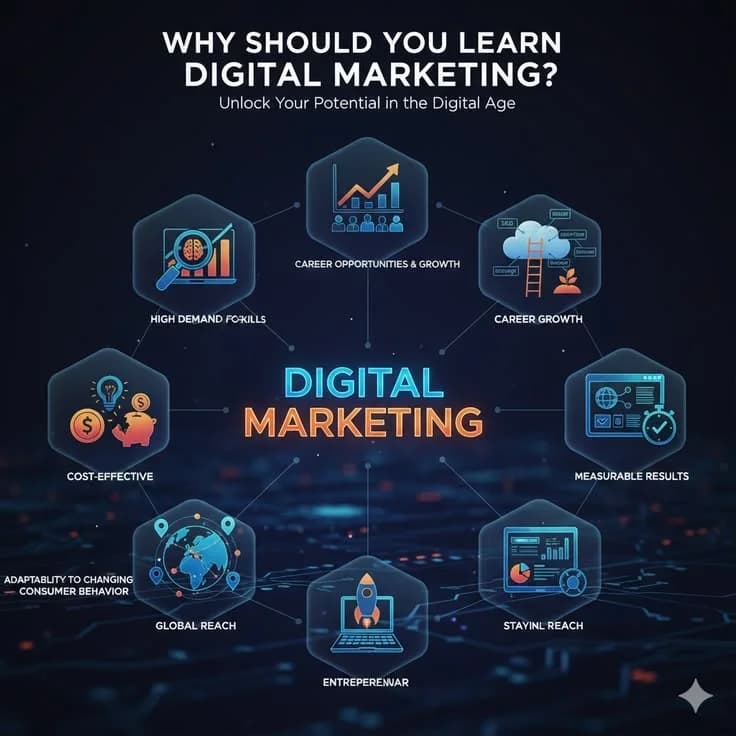
Now that we have seen the ladder, here is what climbing it can give you. • Career options in many industries. Education, healthcare, real estate, retail, finance and entertainment all need digital marketers.
• Multiple ways to earn. You can take a job, freelance, run a small agency, manage your own business or build a personal brand.
• A skill that is visible. Rankings, campaign results, websites and creatives become a portfolio that speaks for you.
• Open to all backgrounds. Engineers, commerce graduates, arts students and career changers all succeed in this field.
• Continuous growth. Platforms keep changing, which means there is always something new to learn and a new way to stand out.
• Entrepreneurial confidence. Once you can generate customers online, starting your own venture feels far less risky.
The Strategy: How to Choose and Climb
The box in the lower right of the poster says it clearly: "Choose the skill that matches your goals." That line is the heart of a good learning strategy. You don't have to master all eight skills at once, and you shouldn't try. Start with your goal, then pick the path.
• Goal: get a job at an agency or company. Focus on SEO, Google Ads and GA4 first, then add Meta Ads. These are the skills most job descriptions list.
• Goal: freelance or start a small agency. Combine WordPress and Elementor, Canva and Meta Ads so you can deliver complete packages to local businesses.
• Goal: grow your own business. Prioritise Meta Ads, Canva and CRM, so you can attract customers and follow up on them yourself.
• Goal: become a content creator or personal brand. Start with Canva, SEO and AI tools, then add analytics to understand your audience.
Whichever path you choose, follow the Learn, Practice, Grow loop printed under the Acadvizen logo. Learn the concept. Practise it on a real website, page or small ad budget. Then review the data and grow by improving. Skipping the middle step is where most people get stuck.
A few habits make the strategy work better
• Build a portfolio from day one: a small website, a few ranking blog posts, a test campaign with screenshots of results. • Specialise after you generalise. Learn the basics of every step, then go deep in one or two skills. • Track everything in GA4 so your claims are backed by numbers. • Use AI tools to speed up your work, but always review and edit the output yourself.
A quick example
Imagine a mechanical engineering graduate who wants to move into marketing. In the first month, she learns SEO basics and publishes three blog posts on a simple WordPress site. In the second, she runs a small Google Ads test and a Meta Ads lead campaign for a local tuition centre, with GA4 tracking both. In the third, she organises the leads in a free CRM and designs creatives in Canva. She now has a website, live results and a story to tell in interviews. That is the ladder in action.
Why Digital Marketing Is Not Working for Many People
This is the honest part. Plenty of people finish a course and never get the career they hoped for. Plenty of business owners spend money on ads and see nothing. Digital marketing isn't broken. The approach usually is. Here are the most common reasons.
- Learning tools instead of strategy
Knowing where to click inside Google Ads or Canva is not the same as knowing what to do. Tools change every few months. Strategy, meaning understanding audiences, offers, funnels and measurement, stays valuable. A course that only teaches buttons produces people who panic when the interface changes.
- Too much theory, not enough practice
Marketing is learned by doing. If you never spend real money on a test campaign, never publish a real blog, or never build a real website, you will freeze in your first interview. Employers want to see what you have actually done.
- Trying to learn everything at once
The ladder has eight steps, and beginners often jump between them without finishing any. The result is shallow knowledge of everything. Follow an order and complete each step with a small project before moving on.
- Chasing certificates over skills
A certificate helps, but a portfolio convinces. Hiring managers will ask you to explain a campaign or audit a page. If you can't, the certificate won't save the interview.
- Ignoring analytics
Many learners create content and run ads but never look at the data. Without GA4 and conversion tracking, you can't tell what is working, so you repeat mistakes. Measurement is what separates marketers from people who simply post online.
- Unrealistic expectations
Some people expect to earn big money within a month. SEO takes time. Ads need testing. Brand building needs consistency. Digital marketing rewards patience, steady practice and honest review of results.
- Forgetting the follow-up
Business owners often run great ads and then lose the leads because nobody calls back promptly. Without a CRM and a clear follow-up process, even strong campaigns appear to fail.
- Weak website and offer
Ads send people to a page. If the page loads slowly, looks untrustworthy or doesn't explain the offer, visitors leave. No amount of ad budget fixes a poor landing page or an unclear offer.
- Over-relying on AI
AI-generated content that is generic, repetitive or inaccurate hurts rankings and trust. AI is a helper. It cannot replace research, originality or understanding of your audience.
- Inconsistency
Posting for two weeks and quitting, or running ads for three days and giving up, doesn't give any channel time to work. Consistency, tracked and improved weekly, is the quiet reason successful marketers succeed.
How to Choose the Right Digital Marketing Course in Bangalore
Bangalore has no shortage of institutes, so the choice can feel overwhelming. Use this checklist before you enrol: • The syllabus covers the full ladder: SEO, Google Ads, GA4, Meta Ads, website building, design, CRM and AI. • You work on live projects, not only slides and recordings. • Trainers have practical industry experience and can show their own campaigns. • The course is updated for current tools such as GA4, PMax and AI workflows. • You receive portfolio guidance, interview preparation and career support. • Batches are small enough for you to ask questions and get feedback.
A good institute doesn't promise overnight success. It gives you a structure, real practice and honest feedback, which is the philosophy behind the Learn, Practice, Grow line in the Acadvizen branding.
Frequently Asked Questions
Can a non-technical person learn digital marketing?
Yes. Most tools are visual and beginner-friendly. Curiosity, consistency and practice matter more than a technical background.
Which skill should I learn first?
SEO and Google Analytics are strong starting points because they teach how people search and how to measure behaviour. After that, choose according to your goal.
How long does it take to become job-ready?
It varies, but a focused learner who practises on real projects can build a job-ready portfolio within a few months. Mastery continues for years.
Will AI replace digital marketers?
AI will replace repetitive tasks, not strategic thinking. Marketers who learn to use AI tools well will have an advantage over those who don't.
Final Thoughts: Take the First Step
The poster shows a young learner standing at the bottom of a staircase, looking toward a sunlit skyline. The message is simple. The path exists, each step is a skill you can learn, and you decide how far to climb.
A degree is a strong start, but opportunity goes to people who can apply what they know. A well-chosen digital marketing course in Bangalore, combined with real practice and steady effort, can turn that knowledge into a career. Pick the skill that matches your goal, begin on the first step and keep moving.