What to Expect After 'Publish'
Many digital marketers have experience setting up ads, excited to see their results in real time. However, ad spend balloons out of control with little to no return on investment. It can be very frustrating. The good news is that nothing is wrong with the way you are using the platforms. The bad news? You may be missing a strategy to back up your efforts.
A solid strategy will equip you to know your ideal audience, craft the perfect message to meet them where they are, and assist you in deciphering how your efforts impact your business. Strategy is the game changer to help you optimize your digital marketing campaigns.
Failure to Implement a Strategy
The good news? Most people aren't trying to fail. They are trying to succeed and most likely have the best intentions. Unfortunately, people can become enamored with the idea of marketplace flexibility or being quick to change and pivot strategy, when in fact, strategy is lacking. It may look something like this:
-launching ads as soon as a product is released as opposed to doing the research to uncover the audience's pain points
-making the decision about how much to spend based on your month to month cash flow as opposed to determining the cost necessary to generate a lead.
-guessing what your audience wants to hear as opposed to doing the research to uncover the audience's objections.
- Keywords identified as "relevant" instead of reflecting actual search intent or buyer's journey stage.
- KPIs are superficial and focused on vanity metrics (impressions, likes, clicks).
There is no funnel. There are no defined outcomes. There are no limits to the ad spend.
The Loss of Not Having a Digital Marketing Strategy
Most startups and growing companies assume that developing a strategy is a privilege for large corporations. The truth is that strategy is more valuable for small businesses since large parts of the small business's budget can be wasted if the wrong target audience is identified and the business's message is communicated via the wrong channel.
Absence of a digital marketing strategy usually results in poor performance of the campaign and wastage of company's resources in the following ways; a company's budget is divided into many unverified audiences, the company's message remains broad and thus fails to capture the interests of any specific audience and ultimately, the company is unable to identify the reason for the poor performance of the campaign.
Leakage in Our Ad Strategies
There’s a reason Google Ads is such a profitable channel. They’ve structured their ads to reward intent. Intent meaning, are people searching for your product? As you can imagine, if your structure is convoluted and disorganized, Google is not going to reward you. Some of the more common structure mistakes are broad match modifiers, which allow Google to interprete search queries however they see fit and result in irrelevant traffic, large and unmanageable ad groups, and landing pages that don’t correlate with the search query. The biggest issue with all of these, is the account structure is designed to burn through your budget, not generate a return.
With Meta, their ads are designed to interrupt. So, people aren’t actually searching for what you’re offering, they’re scrolling. This means your ad has to work to capture their attention. If you don’t have a clear ad strategy, eventually your ads will turn stale and results will decline. Additionally, many businesses neglect to define and distinguish between the different objectives, e.g. awareness, consideration, etc. This frequently leads to an over-reliance on a cold traffic ad, and a lack of ad targeting to capture users at various points along the consumer journey. This results in a ton of ad impressions and virtually no prospective clients.
SEO Strategy: Where's Our Website Traffic?
There are consequences for not having a strategic plan for almost every area of a business. For lack of an SEO strategy, blog posts get published without regard for keywords. Important technical elements of SEO (like website speed and mobile usability) and internal links get overlooked. As a result, the business believes that it’s only a matter of time before the search engines figure it out and reward the business with website traffic. Search engines do reward businesses with website traffic, but not without relevant and well thought out content published over a period of time. Consistency is rewarded with higher website traffic and lower website traffic is the consequence of an absent strategy.
Where Digital Marketing Strategy is Actually Helpful
Without a digital marketing strategy, things are pretty much the opposite.
- Without strategy, goals are fuzzy and every rupee spent is based on speculation.
- Ads get shown to the wrong people and click-through rates suffer.
- A business’s marketing spend is wasted because the convert very few people.
- A business works really hard to become the world’s best kept secret.
- Marketing returns are negative, and there’s no way to measure.
•Compounding results: Unlike other forms of advertising, SEO content and retargeting efforts build up over time. After the initial month’s work, effects of the efforts carry over.
•Advantage over the competition: Most small and medium businesses don’t have an integrated marketing strategy, and rely on high ad-spend. An organized strategy will give you an edge.
A modest budget goes a long way when strategy and implementation are aligned. Effective marketing is measurable. A strong, strategic marketing foundation will increase lead generation and improve customer retention rates.
Building a Simple Strategy Framework You Can Actually Use
A strategy can’t simply be a long document to be effective. For a small to medium business, there are a set of questions that must be answered in writing to ensure campaign strategies are aligned. Those questions are:
- Who is our target market?
- What is the objective of the campaign?
- Where will the campaign be run?
- What will the campaign say and how will it be communicated?
- How will the campaign be measured?
Answers to these questions will help determine the structure of a Google or Microsoft campaign. Additionally, it helps answer what and how content will be developed and communicated to the target audience.
5 Signs Your Marketing Campaigns Are Running Blind
Are your marketing campaigns being run haphazardly and without a true North? Here are five tell-tale signs.
- You can not articulate your target audience.
- Your advertisements lack a central marketing message.
- You can not attribute a cost to lead.
- Your marketing campaign is not measured against a business objective.
- Your marketing campaign is not integrated across multiple platforms.
Your ads don’t necessarily target the most effective platforms; they’re just distributed evenly among many. Consequently, your ad budget isn’t maximized for the best return.
You evaluate the success of your ads based on impressions and reach instead of spending to lead or spending to sale metrics.
Your ads don’t support specific, relevant landing pages and instead direct users to your generic homepage.
Once your ads are launched, there is no effort to update your creatives or modify your targeting based on the performance of your ads.
Each of the issues listed above is more prevalent than the platform limitations themselves. In the end, strategy trumps ad spend. Focused strategic work will nearly always get better results than an increase in your ad budget.
Institute A will get only average results but Institute B will get significantly better results. At Institute B, every single Rupee will be assigned a specific job to do, and that's why Institute B will be able to maximize their return on investment (ROI).
Marketing Strategy for Each Part of the Customer Journey
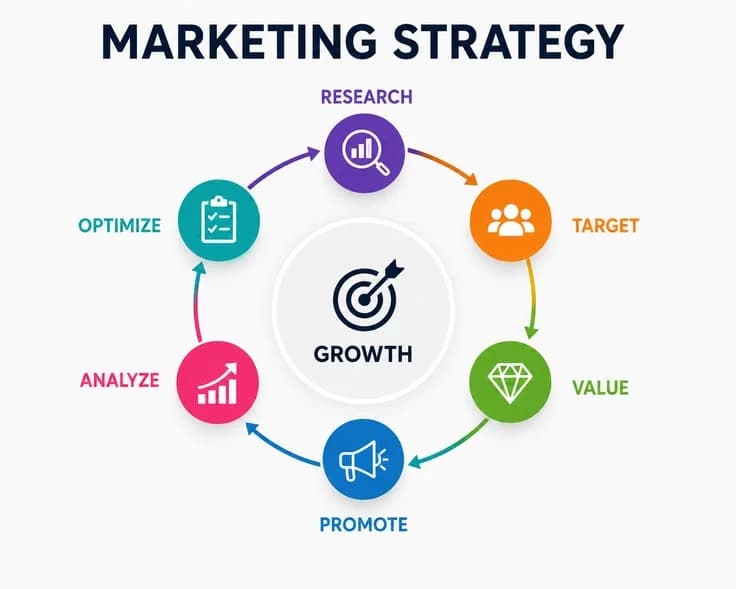
By not having a marketing strategy, Institute A will focus equally on all parts of the customer journey which is usually spent trying to push a sale. A marketing strategy will allocate different methods of marketing for each part of the customer journey. For the top part of the customer journey, marketing will focus on building brand awareness and trust via content marketing. For the middle part of the customer journey, marketing will focus on building and earning trust via endorsements, comparisons and/or testimonials. For the bottom part of the customer journey, marketing will focus on promoting offers via pay-per-click (PPC) advertising.
While focusing solely on the bottom part of the customer journey can work, a marketing strategy will reveal that the target audience is not ready for a sale and therefore the campaign will not be effective. By not having a marketing strategy, Institute A will spend a lot of money on marketing campaigns that will not generate any sales.
Frequently Asked Questions
What is a digital marketing strategy?
A digital marketing strategy outlines the key components of your marketing plan in advance. These components typically include the target audience, the desired action, the marketing channel and messaging, and the performance metrics.
Can I successfully run Google or Facebook ads without a strategy?
You can experience short term success without a strategy, but it is unlikely that you will achieve long term success. If you do not define your target audience and restrict your message to specific components of your audience, you will be wasting your marketing spend.
What does an SEO strategy encompass that "blog post schedule" does not?
Scheduling a blog post does not encompass researching what your audience is searching, developing a strategy to target those queries, or ensuing your website's pages are logically connected (i.e. internal linking).
What is a direct consequence of an advertisement being strategy-less?
If you do not know your target audience at the campaign level, you do not know the audience that you want to reach and you probably do not know the value that you want your audience to take (i.e. the action). Additionally, if you do not set a value for your target audience at the campaign level, you do not know if your campaign was successful.
Q: Is the marketing ROI automatically improved with a new strategy?
A: With paid advertising strategies (i.e. Google Ads and Meta Ads), marketing ROI generally improves rather quickly. This is because the advertising strategies can be refined rather quickly, and continuously, to capture the target audience. With organic strategies (i.e. SEO), it generally takes longer (3-6 months) to see improvements. However, with an SEO strategy, the effects generally last longer and continue to grow (compound) over time.
Q: Is a larger team or agency required to develop a digital marketing strategy?
A: Not really. The development of the strategy is generally the harder and longer part. The real challenge is often the execution. So, a team or agency is generally just speeding up the process. If one person has a developed framework, a strategy can generally be developed rather quickly (i.e. afternoons or days).
Strategy Is Ongoing
A strategy is generally developed and then filed away, never to be seen again. However, the framework should be regularly (weekly) assessed to evaluate the marketing efforts and to make refinements to the strategy. Most effective marketing strategies are assessed and evaluated regularly.
The Bottom Line
Many businesses assume that Google Ads, Facebook Ads, and other similar platforms are marketing solutions. In reality, these are marketing tools. Using marketing tools without a plan will lead to expenditure and an impression count. However, it will not give any idea of what it means to be successful. Defining success is the responsibility of the marketer. It is advisable to come up with a marketing plan and strategy and document it before the execution of a marketing campaign.
Is It Time To Take Our Marketing Seriously?
It is likely that going over this post has happened multiple times. Fortunately, this is not the time that will require a significant effort and expense to resolve. The underlying foundation of all marketing is strategy.
A comprehensive course in marketing that we offer at AcadVizen (Jayanagar, Bengaluru) focuses on developing marketing strategies and their implementation. We provide our students with several opportunities to develop and implement marketing strategies. These opportunities include actual marketing campaigns. If a strategy is developed and implemented, the success of a marketing campaign is guaranteed. Contact us to know more about our next batch.